
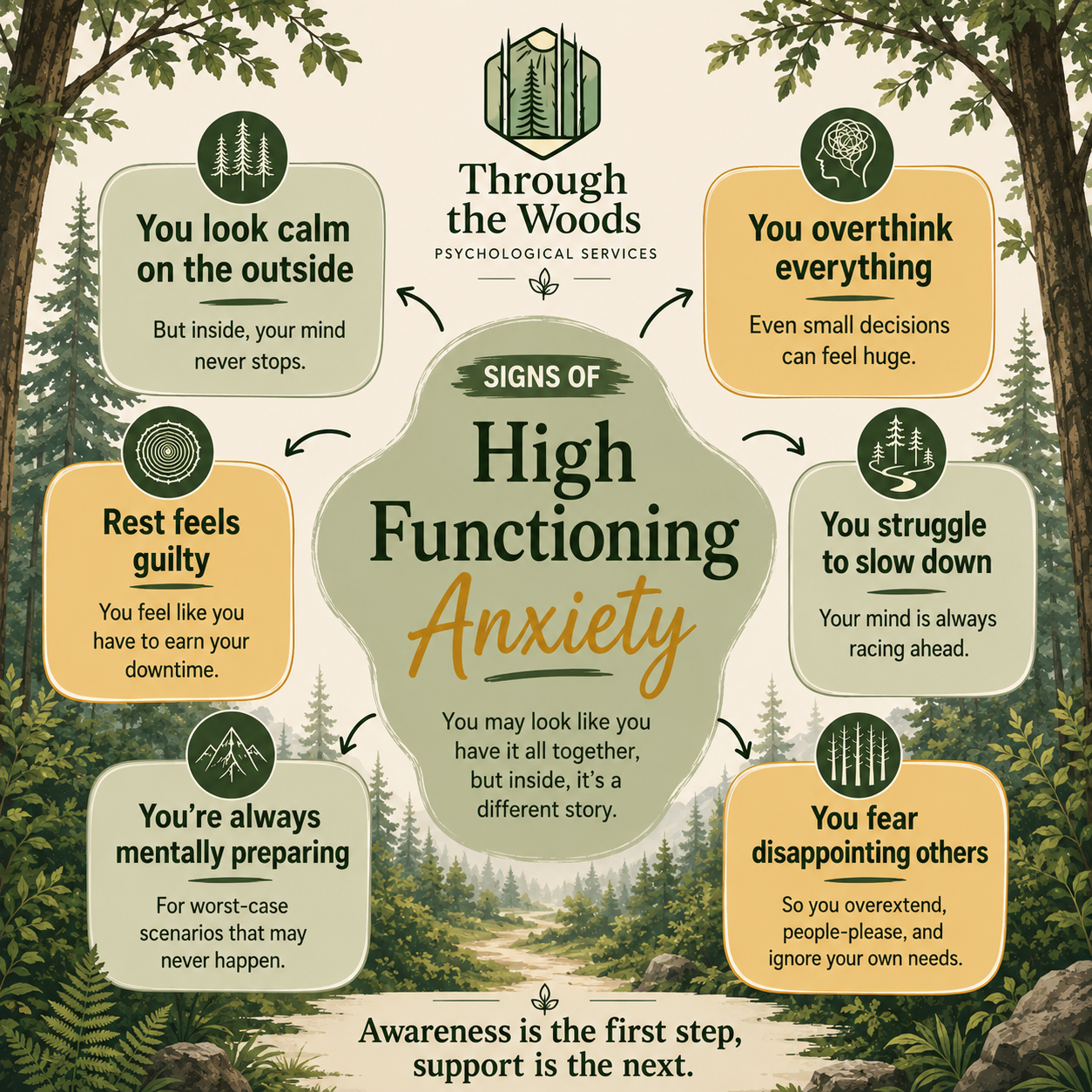
What Are the Signs of High Functioning Anxiety?
High functioning anxiety does not look the way most people imagine anxiety looks. There is no obvious panic, no visible distress, and often no indication from the outside that anything is wrong at all. People with high functioning anxiety frequently appear confident, capable, and in control. They show up on time, meet their deadlines, and hold their lives together with apparent ease.
What others do not see is what it costs.
Through The Woods Psychological Services works with clients across New York City who carry this kind of anxiety every day. Here is what high functioning anxiety actually looks like from the inside.
What High Functioning Anxiety Is
High functioning anxiety is not a formal clinical diagnosis in the way that generalized anxiety disorder or panic disorder are. It is a widely recognized pattern that describes people who experience significant anxiety but continue to function at a high level despite it, often using their anxiety as fuel rather than being stopped by it.
The anxiety is real. The worry, the hypervigilance, the physical tension, and the mental exhaustion are all present and often intense. The difference is that the person has developed ways of managing their outer life that mask what is happening internally. This masking is often so effective that the person themselves may not fully recognize how much anxiety is driving their behavior.
You Appear Calm But Your Mind Never Stops
One of the most consistent features of high functioning anxiety is the gap between outward appearance and internal experience. While everything looks fine on the surface, the mind is running constantly. You are rehearsing conversations before they happen. You are replaying interactions after they end, analyzing what you said and how it landed. You are anticipating problems that have not occurred yet and preparing responses to scenarios that may never happen.
This mental activity is exhausting in a way that is hard to explain to people who do not experience it. You can be sitting still in a quiet room and feel completely depleted because your mind has been working at full capacity for hours.
You Are a High Achiever Who Can Never Quite Feel Satisfied
Many people with high functioning anxiety are driven, accomplished, and externally successful. Achievement is often both a coping mechanism and a source of relief. Completing a task, meeting a goal, or receiving positive feedback quiets the anxiety temporarily. The problem is that the relief never lasts. The bar moves. The next task demands the same level of effort and worry as the last one.
This produces a cycle where high performance becomes necessary to manage anxiety rather than something pursued from a place of genuine engagement or enjoyment. Accomplishment feels less like success and more like brief relief before the next worry arrives.
You Overthink Decisions and Struggle to Settle
Decision-making can be genuinely difficult with high functioning anxiety even when the decisions are objectively small. You gather information, weigh options, consider outcomes, and still feel uncertain about the choice you make. After deciding, you continue second-guessing.
Bigger decisions can produce extended periods of rumination that are disproportionate to the actual stakes involved. The cognitive energy spent on decisions is significant and leaves less available for everything else.
Physical Symptoms You Have Normalized
Anxiety lives in the body as well as the mind. People with high functioning anxiety often carry physical symptoms they have come to accept as normal because they have been present for so long. Tight shoulders and neck tension that never fully release. A stomach that is frequently unsettled without a clear physical cause. Headaches that arrive at predictable high-stress points. Difficulty falling asleep because the mind will not slow down at night. Waking early with a rush of thoughts before the day has begun.
These symptoms are not separate from the anxiety. They are expressions of it. When the anxiety is addressed directly, many clients find that physical symptoms they assumed were unrelated begin to improve.
You Have Difficulty Saying No and Overcommit Regularly
A strong need to meet expectations, avoid disappointing others, and maintain a reliable image leads many people with high functioning anxiety to take on more than they can comfortably handle. Saying no feels risky even when yes is genuinely not manageable. The fear of being perceived as less capable, less helpful, or less reliable than expected overrides the awareness that the commitment is too much.
The result is a consistently full schedule, a pattern of overdelivering, and a private experience of resentment and exhaustion that rarely gets expressed because expressing it feels like a further sign of inadequacy.
You Use Productivity to Manage Worry
Staying busy is one of the most common strategies people with high functioning anxiety use to manage internal discomfort. When you are focused on a task, the anxiety has less space to expand. Productivity becomes both genuinely useful and a way of outrunning feelings that surface when things slow down.
Stillness becomes uncomfortable. Rest feels unearned. Doing nothing produces a low-level agitation that makes relaxation feel more stressful than staying occupied.
Why High Functioning Anxiety Often Goes Unaddressed
Because the external signs of high functioning anxiety look like competence rather than distress, many people spend years without recognizing it as something worth addressing professionally. They attribute the exhaustion to a busy life, the overthinking to conscientiousness, the physical tension to stress that everyone experiences. They function well enough that seeking help does not feel justified.
But functioning is not the same as thriving. Managing anxiety is not the same as living without it. The cost of sustaining high functioning anxiety over years without support is real and accumulates over time in ways that affect health, relationships, and quality of life.
Therapy Helps With High Functioning Anxiety
Cognitive behavioral therapy is one of the most effective approaches for high functioning anxiety. It helps identify the thought patterns and behavioral cycles that maintain anxiety and builds new ways of responding to uncertainty, imperfection, and the fear of others’ expectations. Many clients find that addressing the anxiety directly produces changes not just in how they feel but in how they perform, relate to others, and experience their daily lives.
Through The Woods Psychological Services has experienced psychologists and psychotherapists serving clients across New York City. If what you have read here sounds familiar, we are here to help.
With over 60 positive reviews from NYC clients, Through The Woods is a practice that understands what high functioning anxiety actually looks like.
Call us today or schedule consultation to learn more about how family therapy can support your loved ones.
Let’s walk through the woods—and into healing—together. You can also view our Google Profile by clinking here.