Why Does Your Brain Have a Negativity Bias?
You receive ten positive pieces of feedback and one criticism. Which one do you think about on the drive home? You have a good day interrupted by one difficult interaction. Which moment stays with you? You can name your failures more quickly than your successes. You worry about what might go wrong more readily than you anticipate what might go right.
This is not a character flaw. It is how your brain is built. Through The Woods Psychological Services works with clients across New York City on the thoughts and patterns that affect mental health. Understanding negativity bias is a starting point for changing the relationship you have with your own mind.
What Negativity Bias Actually Is
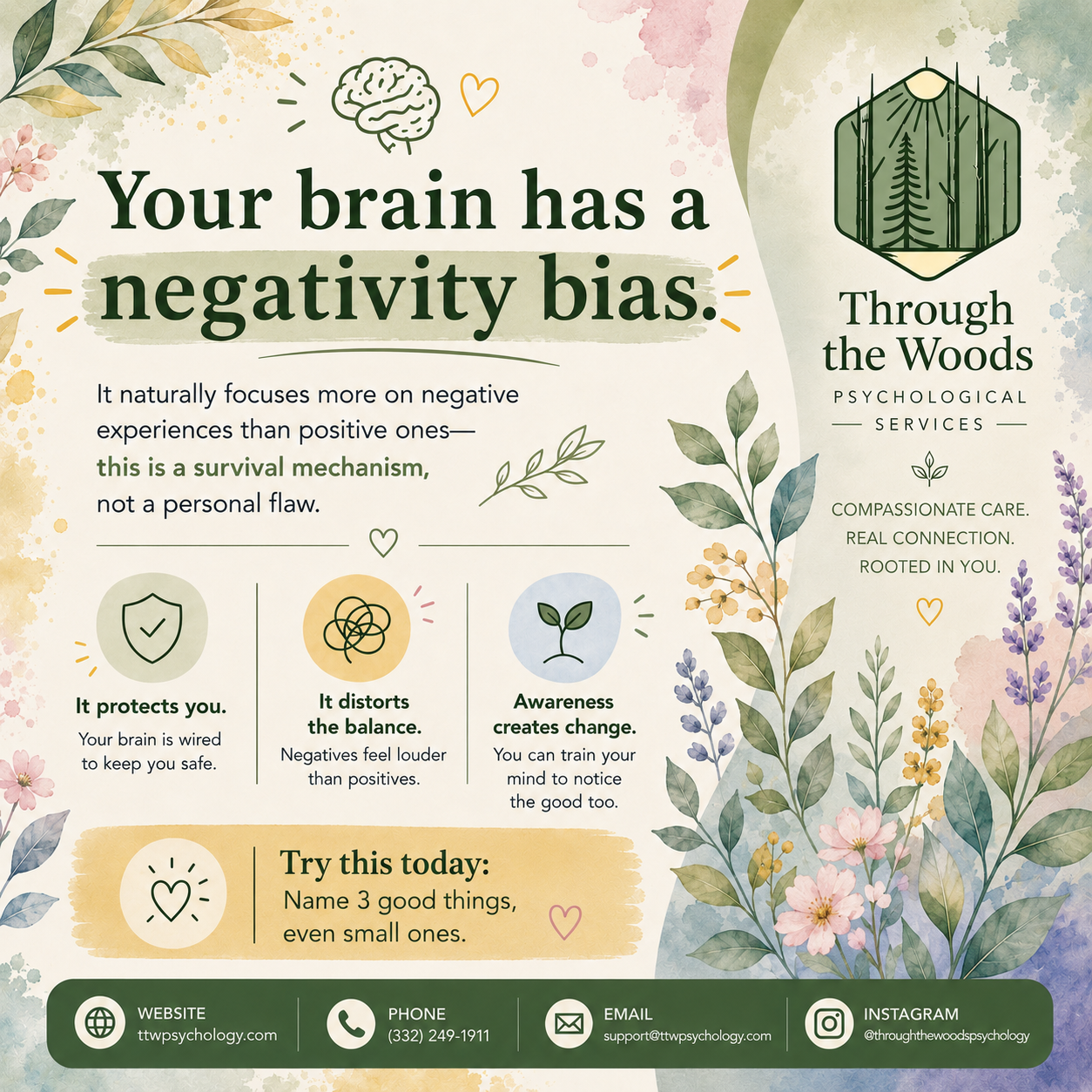
Negativity bias is the brain’s tendency to register, process, and remember negative experiences more intensely than positive ones of equal or even greater magnitude. It is not selective pessimism or a bad attitude. It is a deeply wired feature of human cognition that operates largely below conscious awareness.
Research in psychology and neuroscience has consistently demonstrated that negative stimuli produce stronger and more lasting neural responses than positive stimuli. The brain devotes more cognitive resources to processing threats, losses, and criticism than it does to processing gains, safety, and praise. This asymmetry is measurable and consistent across people and cultures.
Why the Brain Evolved This Way
Negativity bias exists because it was useful for survival. In the environment where human brains evolved, missing a threat was far more costly than missing an opportunity. An ancestor who failed to notice a predator did not survive to pass on their genes. An ancestor who missed a food source had another chance tomorrow.
The asymmetry of those stakes shaped a brain that pays disproportionate attention to potential danger. Negative information gets prioritized because historically, negative information was more likely to be immediately life-threatening than positive information was life-sustaining.
The problem is that this same brain now operates in an environment full of social threats, professional pressures, and information overload that triggers the same ancient alarm system. The brain that evolved to scan for predators is now scanning for rejection, failure, and criticism with the same level of urgency.
How Negativity Bias Shows Up in Daily Life
Negativity bias shapes thought and behavior in ways most people do not consciously recognize. Critical feedback carries more weight than praise and is remembered longer. Losses feel more significant than equivalent gains. Unresolved conflicts occupy more mental space than resolved ones. Risks are weighted more heavily than potential rewards in decision-making. A single bad experience in a place or with a person creates a stronger impression than multiple good ones.
In relationships, negativity bias means that negative interactions carry more emotional weight than positive ones. Research by psychologist John Gottman found that relationships require roughly five positive interactions to offset the impact of one negative one. This is not because people are ungrateful. It is because the brain processes negative relational experiences as higher-priority information.
The Connection Between Negativity Bias and Mental Health
Negativity bias is not the same as depression or anxiety, but it creates the cognitive terrain on which both can develop and persist. A brain wired to attend to threat and retain negative experience is more vulnerable to rumination, catastrophizing, and the kind of persistent worry that characterizes anxiety disorders.
When negativity bias interacts with life stress, difficult experiences, or a history of adversity, it can amplify those experiences and make them harder to process and integrate. The brain’s tendency to dwell on what went wrong, what might go wrong, and what others might think creates thought loops that are difficult to interrupt without deliberate effort or professional support.
This is one of the reasons cognitive behavioral therapy is effective for anxiety and depression. CBT directly targets the thought patterns that negativity bias produces and builds the capacity to evaluate experiences more accurately rather than through the distorted lens of threat-focused processing.
You Cannot Think Your Way Out of It But You Can Work With It
Understanding that negativity bias is a feature of your brain rather than a reflection of reality is genuinely useful. It does not make the bias disappear, but it creates a small but meaningful distance between the thought and the identification with it. The thought your brain produces when things go wrong is not necessarily an accurate assessment of the situation. It is your threat-detection system doing what it was built to do.
Practices that help reduce the dominance of negativity bias include deliberately noticing and attending to positive experiences for longer than feels natural, since positive experiences need more processing time to move into long-term memory. Naming emotions rather than fusing with them reduces their intensity. Physical activity, sleep, and reducing chronic stress lower the baseline activation of the brain’s threat response and create more space for balanced thinking.
When Professional Support Makes a Difference
For some people, negativity bias operates at an intensity that significantly affects quality of life. Persistent rumination, chronic worry, self-critical thinking, and difficulty recognizing or taking in positive experiences are all areas where therapy produces meaningful change.
Through The Woods Psychological Services works with clients across New York City who are caught in thought patterns that negativity bias drives and amplifies. Our team of psychologists and psychotherapists helps clients understand what their brain is doing, challenge the thoughts that do not serve them, and build new patterns of thinking and responding that better reflect their actual circumstances.
With over 60 positive reviews from NYC clients, Through The Woods is a practice where the science of how the mind works informs every aspect of the care we provide.
Call us today or schedule consultation to learn more about how family therapy can support your loved ones.
Let’s walk through the woods—and into healing—together. You can also view our Google Profile by clinking here.